Home / Emergency Drain Cleaning
Home > Plumbing Services > Emergency Drain Cleaning
Emergency Drain Cleaning in Philadelphia, PA
One slow drain is a nuisance. Several drains backing up at once — or sewage rising through a tub, shower, or basement floor drain — can point to a blockage in the main sewer line. Stop using water, keep people and pets away from contaminated water, and arrange professional help before the backup spreads.
- CALL NOW: [VERIFY BUSINESS PHONE NUMBER]
- REQUEST SERVICE: [REQUEST SERVICE / CONTACT]
- Symptom-based assessment — find the likely blockage level
- Appropriate clearing method — match equipment to pipe condition
- Evidence-led recommendations — avoid unnecessary line work
- Clear next steps — understand repair and prevention
What to do when drains back up
If several fixtures are slow, gurgling, or backing up, act as though the restriction may be in the main line until a plumber confirms otherwise. Every gallon sent into the plumbing system can return at the lowest opening in the home.
- Stop using water throughout the property. Do not run the washing machine or dishwasher, take showers, drain a bathtub, or continue using sinks.
- Do not flush toilets. A flush may add enough water to force sewage out of a tub, shower, toilet, or floor drain.
- Keep people and pets away. Treat sewage-contaminated water as a health hazard and avoid skin contact.
- Contain spread only if you can do so safely. Close the affected room, move dry belongings out of the path, and use barriers that do not require contact with sewage.
- Note the pattern. Write down which fixtures are affected, what was running when the problem appeared, whether it followed heavy rain, and whether the same location has backed up before.
- Locate the cleanout if you already know where it is. Do not open a cap that may be under pressure; simply tell the plumber where access is available.
- Ventilate without spreading contamination. Open an exterior window if practical, but do not use fans that could blow contaminated droplets or odors through the home.
- Request professional help. Multi-fixture symptoms, sewage, or rising water from a floor drain require diagnosis beyond a simple local clog.
Safety warning: NEVER use chemical drain cleaners on a severe or suspected main-line clog. They can damage some piping, cause splash burns, and leave a chemical hazard for the plumber. NEVER keep running water to “push through” a suspected blockage. Avoid all contact with sewage-contaminated water.
Need help now?
Signs the problem may be in the main sewer line
A single slow fixture often points to a nearby trap or branch drain. A pattern across the property suggests the restriction may be farther downstream. Symptoms can overlap, so these signs are clues rather than a remote diagnosis.
- Several drains slow at once: The kitchen, bathroom, laundry, or basement fixtures begin draining poorly around the same time.
- Sewage in a tub or shower: Wastewater appears at a low fixture after a toilet is flushed or another fixture drains.
- Gurgling across fixtures: A toilet bubbles when a sink drains, or a shower gurgles when the washing machine pumps out.
- Floor-drain activity: Water pools around or rises through a basement floor drain, especially while water is used elsewhere.
- Persistent sewer odor: An ongoing odor may reflect a trap, vent, drain, or sewer issue and should be investigated rather than masked.
- The same clog returns: Repeated clearing at one location may mean the underlying restriction or pipe defect was not identified.
A toilet backing up (see /emergency-toilet-repair/) can be the first visible symptom of a larger downstream problem. A basement floor drain backup (see /sump-pump-emergency/ for pump-related flooding) can also be confused with sump-pump trouble; note whether the water appears to be sewage and which fixtures were in use.
Possible causes of severe and recurring clogs
Possible causes include material accumulated inside a local drain, a restriction in the main line, or physical damage to the pipe. The right conclusion depends on the symptom pattern, access, clearing response, and — when warranted — camera evidence.
- Grease and food residue: Cooking grease can cool and adhere to kitchen drain walls, catching more debris over time.
- Hair, soap, and product buildup: Bathroom branch drains can narrow gradually until normal use overwhelms the remaining opening.
- Non-flushable material: Wipes — including products marketed as flushable — paper towels, hygiene products, cotton items, and other debris can lodge in a toilet, branch, or main line.
- Tree-root intrusion: Roots seek moisture and can enter through joints or cracks in older sewer laterals. They may catch paper and waste, causing repeat blockages.
- Scale and deterioration: Older cast-iron piping may develop scale or rough interior surfaces that reduce flow and collect solids.
- A sagging section or “belly”: A low section can retain water and debris instead of maintaining normal gravity flow.
- A separated, cracked, or collapsed pipe: Structural damage can restrict flow or allow soil and roots into the line.
- Heavy-rain surcharge: In areas served by combined sewer infrastructure, intense rain can contribute to backup conditions. A plumber may need to distinguish an on-property blockage from a broader sewer condition.
Philadelphia has a large stock of older rowhomes and older underground laterals. Clay laterals, cast-iron interior drains, basement fixtures, and limited cleanout access may affect how a problem is diagnosed and reached. These are considerations — not a diagnosis of any particular home.
When a clogged drain becomes an emergency
Emergency drain cleaning is appropriate when the condition threatens sanitation, habitability, or property. Stop water use and seek prompt help when:
- Sewage is backing up into a toilet area, tub, shower, sink, or basement.
- Every drain is blocked or multiple fixtures are backing up together.
- Water is rising from a floor drain and continues to spread.
- A backup begins during or after heavy rain and does not recede safely.
- Contaminated water threatens finished areas, stored belongings, mechanical equipment, or electrical equipment.
- A business or occupied property cannot maintain safe sanitation.
A single slow sink or tub that remains contained, does not involve sewage, and does not affect other fixtures may be suitable for a scheduled visit. Monitor it, minimize use, and arrange service before it becomes fully blocked.
Electrical safety: If backup water is near outlets, appliances, a furnace, or an electrical panel, do not enter or touch electrical equipment. Keep clear and contact the appropriate emergency or utility service as conditions require.
How a plumber may diagnose and clear the blockage
A plumber may begin by mapping symptoms: which fixtures are affected, where the lowest drain is located, what happened immediately before the backup, and whether the issue is recurring. That pattern helps estimate whether the blockage is at a fixture, in a branch drain, in the building drain, or in the sewer lateral.
Mechanical clearing
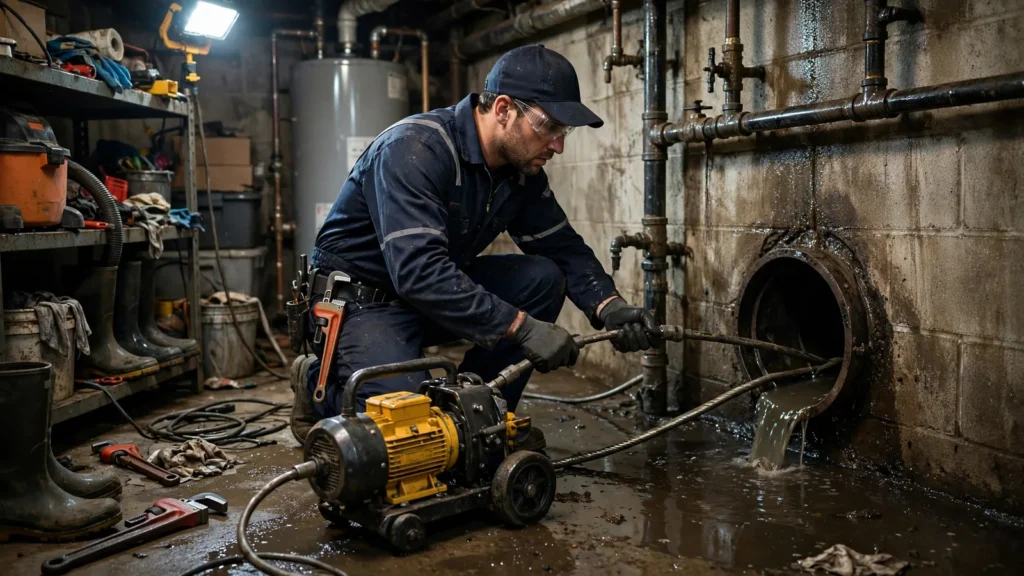
A professional drain cable or auger can break through or retrieve many obstructions. The cable, head, and access point should be selected for the pipe size, material, and suspected blockage. Powered equipment can injure an inexperienced operator and should not be treated as routine homeowner equipment.
Camera inspection
A sewer camera may be used after flow is restored or when repeat symptoms suggest a line defect. It can help identify root intrusion, offsets, cracks, corrosion, standing water, or a collapsed section. A camera view should be interpreted with the line location, depth, flow test, and clearing history; a single image should not automatically trigger an expensive repair.
Hydro jetting
Hydro jetting uses controlled high-pressure water through a specialized hose and nozzle to scour buildup from a drain or sewer line. It can be effective for grease, sludge, and some root-related debris when the pipe is suitable. It is not appropriate for every line. The plumber should consider pipe material, condition, access, and camera findings before recommending it.
Professional drain cleaning should not damage sound piping when the correct method and equipment are used. Fragile, badly corroded, separated, or collapsed piping may already be vulnerable, which is why diagnosis and method selection matter.
Clearing versus sewer line repair
Clearing restores an open path through material inside the pipe. Repair addresses a physical problem with the pipe itself. The appropriate approach depends on inspection; replacement or excavation should not be recommended automatically.
- Soft local blockage — likely path: mechanical clearing. Decision factors: location, access, recurrence.
- Grease or heavy buildup — likely path: jetting if the pipe is fit. Decision factors: material, condition, access.
- Root intrusion — likely path: clear and inspect. Decision factors: entry point, severity, return rate.
- Belly or offset — likely path: monitor or repair. Decision factors: depth, standing water, symptoms.
- Crack or separation — likely path: targeted repair review. Decision factors: extent, location, pipe state.
- Collapse — likely path: repair or replacement review. Decision factors: camera and locating evidence.
If a one-time blockage clears fully and the line appears serviceable, further work may not be necessary. If backups recur at the same point, flow remains restricted, or a camera documents structural damage, repair options may be reasonable. Ask to see the evidence, understand the affected segment, and compare the disruption, durability, and limits of each option.
- CALL NOW: [VERIFY BUSINESS PHONE NUMBER]
- REQUEST SERVICE: [REQUEST SERVICE / CONTACT]
Need help now?
What a typical visit may involve
Every property and company process differs, but a typical visit may involve:
- Reviewing the timeline, affected fixtures, prior clogs, recent plumbing work, and weather conditions.
- Checking several fixtures to determine whether the pattern points to a local, branch, or main-line restriction.
- Locating a safe access point, such as a fixture connection or sewer cleanout.
- Using an appropriately sized professional auger or other clearing method.
- Running a camera inspection when repeat problems or structural damage are suspected.
- Flow-testing the line after clearing and checking the lowest fixtures for renewed backup.
- Explaining what was found, what was not confirmed, and whether monitoring, maintenance, or repair is appropriate.
Limited cleanout access is common in some rowhomes and may change the route, equipment, time, or level of disruption required. The plumber should explain access choices before proceeding.
How to reduce future drain and sewer backups
- Keep grease out of drains. Let fats, oils, and grease cool in a container and dispose of them with solid waste according to local guidance.
- Use hair catchers. Clean strainers regularly in tubs, showers, and utility sinks.
- Flush only toilet paper and human waste. Do not flush wipes, paper towels, hygiene products, cotton items, floss, or litter.
- Address slow drains early. A recurring slowdown is useful evidence and is easier to evaluate before a full backup occurs.
- Know the cleanout location. Keep the area accessible, but do not open a cap during an active backup.
- Keep a simple history. Record dates, affected fixtures, clearing methods, and camera findings so recurring patterns are easier to diagnose.
- Consider evidence-based inspection. For an older lateral with repeated symptoms, a periodic camera review may help track roots or deterioration. It is not a universal requirement for every home.
Why prompt attention matters
Sewage-contaminated water can expose occupants to harmful microorganisms and can damage flooring, walls, cabinetry, and belongings. A partial main-line restriction may still pass small amounts of water, then become a full backup when a washing machine drains or several fixtures are used. Repeated backups also provide information: the line may be narrowing again or a physical defect may be catching debris.
Prompt attention does not mean agreeing to the most expensive work. It means stopping water use, containing risk, restoring flow with an appropriate method, and investigating recurring or structural warning signs before additional damage occurs.
Before the plumber arrives
- Keep all water-using fixtures and appliances off.
- Keep children, pets, and other occupants away from contaminated areas.
- Photograph the backup and affected fixtures from a safe, dry location.
- Write down when it started, which fixtures were running, and whether rain was occurring.
- If known, identify the cleanout location without opening it.
- Clear a dry, safe path to likely access points.
- Tell the plumber if any chemical product was placed in a drain, including the product name if available.
DIY limits: what is safe and what needs a professional
For a single, local toilet or sink clog with no sewage backup and no other fixture symptoms, a correct hand plunger may be a reasonable first step. Stop if the fixture begins to overflow, the problem returns, or another drain reacts.
Reasonable homeowner steps
- Stop water use
- Use a hand plunger locally
- Document the symptom pattern
- Keep occupants away
- Identify — not open — a cleanout
- Remove accessible hair at a strainer
Leave to a professional
- Multi-fixture diagnosis
- Powered drain equipment
- Camera interpretation
- Sewage-contact cleanup scope
- Main-line cleanout opening
- Jetting or pipe repair
Do not improvise: Do not mix drain products, dismantle piping that may be holding backed-up water, open a pressurized cleanout, or use a rented powered cable without appropriate training. These actions can cause chemical exposure, sudden sewage release, pipe damage, or serious injury.
What affects emergency drain-cleaning cost
Actual pricing depends on the property, the problem found, the work authorized, and the business’s pricing. No single price can be responsibly quoted from symptoms alone. Cost factors may include:
- Whether the blockage is at one fixture, in a branch, or in the main line.
- The severity and type of obstruction, including grease, roots, scale, foreign material, or a structural defect.
- Whether camera inspection and electronic line locating are needed.
- Whether mechanical augering or hydro jetting is appropriate.
- The availability and condition of cleanout access.
- Basement layout, tight rowhome access, pipe depth, and other site constraints.
- Whether a damaged segment requires separate repair after clearing.
- After-hours or emergency timing under the company’s verified pricing policy.
Ask what the quoted scope includes, whether diagnosis or camera work is separate, and what evidence would justify additional repair. A clear scope is more useful than an unsupported flat price shown before the line is assessed.
Trust and credentials
Publish only credentials and service commitments that can be documented. Replace each verification marker below only after confirmation.
- Legal business name: [VERIFY BEFORE PUBLISHING]
- Philadelphia service coverage: [VERIFY BEFORE PUBLISHING]
- Business phone number: [VERIFY BEFORE PUBLISHING]
- Hours and emergency availability: [VERIFY BEFORE PUBLISHING]
- Plumbing license details: [VERIFY BEFORE PUBLISHING]
- Insurance status: [VERIFY BEFORE PUBLISHING]
- Drain equipment and methods offered: [VERIFY BEFORE PUBLISHING]
- Written estimate / authorization policy: [VERIFY BEFORE PUBLISHING]
- Workmanship warranty, if any: [VERIFY BEFORE PUBLISHING]
Frequently asked questions
Why are all my drains slow at the same time?
Several slow drains can indicate a restriction in a shared branch, building drain, or main sewer line. Stop heavy water use and have the symptom pattern evaluated; the exact location cannot be confirmed from symptoms alone.
What are the warning signs of a main sewer line blockage?
Common warning signs include several fixtures slowing together, toilets bubbling when other fixtures drain, gurgling across rooms, sewage in a tub or shower, and water rising from a basement floor drain.
What should I do if sewage is backing up into my home?
Stop all water use, do not flush, keep people and pets away, avoid contact with contaminated water, and request professional help. Do not open a cleanout that may be under pressure.
Can I use chemical drain cleaner?
No — not for a severe, recurring, or suspected main-line blockage. Chemical cleaners can damage some piping, cause splash burns, and expose the plumber to hazardous residue.
What is hydro jetting, and is it safe for my pipes?
Hydro jetting uses controlled high-pressure water to scour buildup. It can be effective when the pipe material, condition, and access are suitable. A plumber should assess the line first; damaged or fragile piping may require another approach.
How do tree roots get into sewer lines?
Roots can enter through cracks, loose joints, or separated connections in underground piping while seeking moisture. Once inside, they catch paper and debris. Clearing may restore flow, but camera findings help determine whether the entry point needs repair.
When is a clogged drain an emergency?
Treat it as an emergency when sewage enters the home, multiple fixtures are blocked, water rises from a floor drain, the backup is spreading, or sanitation cannot be maintained. A contained single slow drain may be scheduled.
Will professional drain cleaning damage my pipes?
Appropriate equipment in trained hands should not damage sound piping. Existing corrosion, separation, collapse, or fragile materials can increase risk, so method selection and inspection matter.
How much does emergency drain cleaning cost?
Cost depends on blockage location and severity, access, the clearing method, camera needs, any pipe damage, and emergency timing. Actual pricing must come from the business after it understands the specific situation.
How can I prevent drain clogs?
Keep grease and non-flushable items out, use hair catchers, respond to slow drains early, keep the cleanout accessible, and retain camera or service records when problems recur.
Need help with a severe drain backup?
If several fixtures are affected, sewage is entering the property, or water is rising through a basement floor drain, stop using water and keep the affected area clear. Request professional diagnosis so the blockage can be located and the least-disruptive appropriate option can be discussed.
- CALL NOW: [VERIFY BUSINESS PHONE NUMBER]
- REQUEST SERVICE: [REQUEST SERVICE / CONTACT]
Need help now?
Related services
Emergency Toilet Repair
Overflowing toilet and repeated backups.
Sump Pump Emergency
Sump-pump failure and basement protection.